Monday, November 28, 2011

A life in pictures...


Nice stranger-than-fiction story on Richard Simpkin in the Guardian along with a video that are both worth checking out for their curiosity value alone.

It comes in advance of the gallery show "Richard & Famous" a collection of some 450 of Simpkin's self-portraits with celebrities he has taken since he popped his snapshot cherry with BROS as a teenager in Sydney in 1988.


Simpkin's archive is a strange and unique historical document that chronicles our celebrity saturated culture as well as one man, Simpkin himself, growing up awkwardly alongside some of the world's most famous faces.

Most interesting is that some of his most famous photos somehow take on a different meaning due to the death, divorce or disgrace of the picture's subjects, with Simpkin - his cheeky grin ever-present - seemingly innately understanding that if he just kept going, one day, someone might just ask if they could have their picture taken with him...


Tuesday, November 8, 2011

Remember Me, My Ghost


This weekend I'll be presenting my new film Remember Me, My Ghost for it's world premiere at the 56th Corona Cork Film Festival this weekend. If you're in the area, pop by the Cork Opera House on Saturday afternoon...

Looking forward also to seeing new work by local heroes Lorcan Finnegan, Tom Burke and Darren Thornton in the same programme.


Thursday, October 20, 2011

Nuru Project


Delighted to be supporting the Nuru Project a really innovative idea by J.B. Reed to help raise money for good causes though photography print sales. Some fantastic work on the website and some really good causes to consider being a benefactor to. Everyones a winner...

Sunday, October 9, 2011

Them Bones...


BARE BONES WEBSITE

Legendary illustrator and loving father of the Bare Bones crew Harry Malt has gone and set up a website to represent his ever-loyal flock of miscreant creatives....

What's that Harry?

Take a drink of that Kool Aid??

No thanks mate...mine's a Stella.


Friday, October 7, 2011

Private Photography Review


Private International Review of Photographs features some of my work from Turkana in their 54th issue titled 'Lost'. Stoked also to have the cover page with an image I made in a place called 'Kakong' in North-Western Kenya.

The village, in the marshy borderlands was besieged by the neighboring, more powerful, Pokot tribe. The name of the place itself means 'Eyes' in the local tongue, such was the frequency of armed livestock raids visited on the place.

I made this image while on 'patrol' with the tribesmen, lanky Turkanas wielding AK's; most of them with only one bullet apiece in their magazines. They laughed at me crawling around in the dusty earth with my Rollei and a macro lens while I should have been worried about getting shot at by the feared Pokots.

The ants seemed to sum up the harshness of the place.

The issue of Private is a gem with outstanding essays from all-time photo heroes Roger Ballen and Stephen DuPont, long-term crush Carolyn Drake and a slew of other outstanding photographers. Many thanks to Veronique and the crew.

Get a copy today...


Saturday, October 1, 2011

A Lot More to be Seen


David Hockney 'draws' from the video village. ©David Hockney

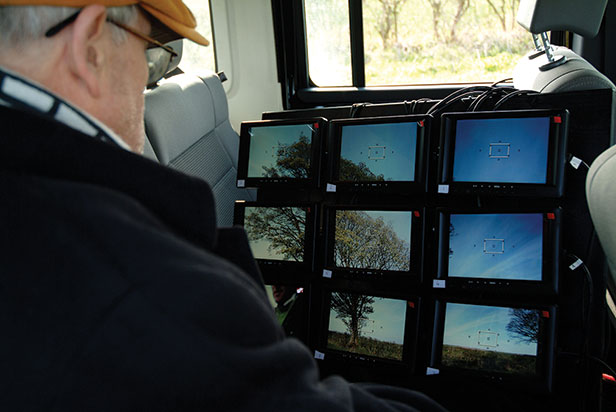
Great article in the Technology Review on David Hockney's latest series of motion collages captured using rigs of multiple DSLR's set up at different points of view. Long an innovator in the photographic medium and an astute commentator on the impact of lens based media on traditional painting and other art practices Hockney's contribution to photography is somehow still overlooked on university courses and by the photo establishment.

"A lot of people have told me," Hockney states, "that before they see these films they can't imagine what nine cameras could do that one can't. When they see them, they understand. It's showing a lot more; there's simply a lot more to see. It seems you can see almost more on these screens than if you were really there. Everything is in focus, so you're looking at something very complicated but with incredible clarity."

Image from the 18 screen video May 12th 2011 Rudston to Kilham Road ©David Hockney

Monday, September 26, 2011

Wattanabe-san


He was a quiet man, the driver. Not that he didn't like to talk or anything, just in that way the Japanese are. Mannered and proud. Contemplative. His car, an aging minivan, was always polished to a high shine despite the places he was working in, his suit always impeccably clean. Each day he'd greet us with effusive handshakes, bows and smiles.

It's fair to say that we liked him immediately, Wattanabe-san.

A regular taxi driver in the quiet city of Sendai until the 11th March, his life had been irrevocably changed by the disaster in a different way than one would expect. Lucky to have escaped the earthquake and the tsunami unscathed; it was the influx of press and media who rushed to his corner of eastern Japan that changed his livelihood from daily city driving to becoming the kind of go-to guy that the media business survives on.

It had been a big leap. Suddenly his normal routine was gone and he found himself working in situations he never thought imaginable, witnessing the aftermath of a national tragedy first hand and learning how the news gets made.

We were no different, the crew of 'Snakedance', relying on his knowledge and his stories to help director Manu Riche and writer Patrick Marnham get a sense of what they might expect from different locations and what the context of each place was.

I felt compelled to take images of Wattanabe in our downtime, dressed as he was, for a funeral.

Always there, hands crossed, staring out at the devastation. He communicated to me in those moments of reflection about how deeply this disaster had affected the people of Japan. I wondered how many times he had visited places like Yuriage and Natori and the subtle differences he was observing in these landscapes as his countrymen began the mammoth clear up. I wondered too how he felt about working with the media and their need to pry into the lives of ordinary people.

I wondered about Wattanabe and almost didn't have the chance to ask him these questions. Finally on the last day in his car on our way back to Fukushima train station to catch the bullet train to Tokyo we had the chance to hear his thoughts.

In choosing the music for this short, editor Carter Gunn sent me this synopsis relating to the track he had chosen:

Sai-bara is a kind of gagaku song that is grew out of the folk songs of horsemen….basically the folk song of someone who owns a horse and sort of used the horse like a taxi cab (holding the reins while the rich person rode on the horse, because the rider is above the horse person in class)…
Sai-bara was eventually, during the 700′s, influenced by gagaku or entered the canon of gagaku and became more of a proper song.