Showing posts with label Irish Eyes. Show all posts

Friday, February 18, 2011

Irish Eyes: Alen MacWeeney


Like a long-legged fly upon the stream
His mind moves upon silence.

That the topless towers be burnt

And men recall that face,

Move most gently if move you must
In this lonely place.

She thinks, part woman, three parts a child,

That nobody looks; her feet

Practise a tinker shuffle
Picked up on a street.

From 'Long-Legged Fly' W.B. Yeats, 1938


It's been a while since the last installment of the 'Irish Eyes' interview series here on the blog and no better way to kick off the new year (-ish) with the opportunity to catch up with Alen MacWeeney, photographer of a towering body of documentary work 'Irish Travellers: Tinkers No More'.

MacWeeney's images appeared to me at a time when frustration and a lack of inspiration were dominant in my photographic world. My usual tricks of poring over 'Dorchester Days' for motivation had begun to fail me and the short days and harsh, dwindling light of Irish winters were only adding to my laziness and my yearning for the photographic exotic; somewhere, anywhere else.

And then I found it, this exotic, in the most unlikely source, close to home. So close to home in fact I wondered how I had never seen these amazing pictures. It was true that the great American photographers had been here to snap pictures of the Irish Gypsies: Dorothea Lange and Mary Ellen Mark among others, but MacWeeney's images were something different, filled with pathos and intimacy.

Not only was the photo book laden with heartbreaking images but also a series of recordings of the Irish Travellers from Cherry Orchard and other 'gyspy' campsites that Alen had gathered during his time photographing 'Tinkers No More', documenting perhaps the most important thing about this unique culture: it's oral history. Songs and conversations, poems and voices spoke from inside caravans from an era long since disappeared. Romantic Ireland was indeed dead and gone.

In essence what Alen managed to capture was a certain interior migration that fundamentally changed the Irish Traveller culture and experience forever, something that does not exist in history books, anthropological studies or any other documents. An essential piece of work by any standards, it's a great pleasure to be able to hear Alen discuss the project in his own words...
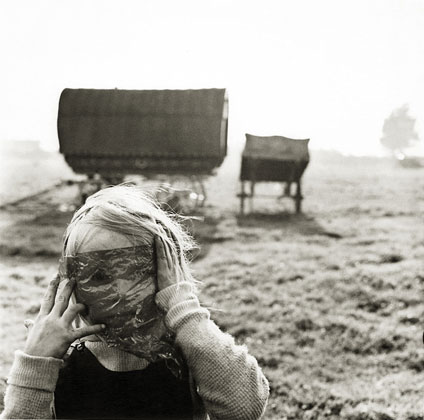
'Child with Cellophane, Cherry Orchard.' by Alen MacWeeney. Copyright 1965

First off, I’d love to get a bit of background to ‘Tinkers No More’. You were living in the US at the time and starting your career as a photographer. What was it like returning to Ireland with a camera in your hand? Things have changed so much there, can you give us your impressions of ‘going home’…

Before my involvement with Travellers, going back in time after a year of assisting Richard Avedon in New York in ’62, I returned to Ireland with an idea of making portraits of the men and women of the Catholic Church, the priests, the nuns, and the church leaders who control the church in Ireland.

But, I failed to find support, or indeed have the wherewithal myself at 22 years of age to manage the underpinnings needed to gain both access and recommendations for the project. At that time there was no hint of scandal attached to the church.

So, I put my Hasselblad aside, bought a Leica, and went out into the streets to photograph for the best part of the next two years in Dublin.

Unlike portrait photographs, which involve choosing and directing not only the subject, but the situation and everything else; I chose street photography which is dependent seeing an image in a myriad of moving parts. And, in essence requires synthesizing a confluence of elements, to make an image in a moment.

I returned to New York in 1964 as a place to find work and where photography found a more supportive audience in a country of limitless possibility. The centenary of the poet W.B. Yeats was in 1965. Harpers Bazaar magazine promised me some pages based on my proposal of a photo essay about the poet and his sources: of the kinds of people, places and things in his poems. With the help of others, I left New York for a year long stay in Ireland to begin this project.


'Woman in a White Dress, Dublin.' by Alen MacWeeney. Copyright 1965


'Watching: A Dublin Street Scene' by by Alen MacWeeney. Copyright 1965


'Glowing White Pony, Ballinasloe Horse Fair' by by Alen MacWeeney. Copyright 1965

Did you know that working with the Traveller community was something you wanted to do or like all great photo essays was it something you just stumbled upon?

I was out one day looking for a Tinker woman to photograph as part of the Yeats essay, and by accident (as I am convinced is the best way to begin anything) I came across a big sprawling field that was a Traveller’s campsite on the scruffy outskirts of Dublin, opposite Cherry Orchard fever hospital.

I went through a gap in the hedge and into a hut and met with Joe Donaghue there, the self-styled leader of the camp. We talked (or rather he talked and I listened) and he gave me a well rehearsed monologue over the next few hours of the injustices the Travellers had been subjected to by the authorities in Dublin and aided by the church. After our initial meeting, I brought up a tape recorder the next day, which became my passport, it lent an air of seriousness and purpose to the interviews. The tape recorder was my ally and helped me to interview many other Travellers in the years ahead.


'Joe Donoghue and Olivene, Cherry Orchard.' by by Alen MacWeeney. Copyright 1965

What I found there in Cherry Orchard would occupy me for the next five years was a deep well of a hidden Irish culture. The Travellers went to Dublin to collect the dole; before ’63 there was none. They could now send their children to school, and due to an increase in motor traffic and restrictions to camping along the roadsides it was difficult for them to maintain that older way of life. By accident, I coincided with the exodus of Travellers from the country into the city.


'Building a hut, Cherry Orchard.' by by Alen MacWeeney. Copyright 1965


'The Ward Family, Cherry Orchard.' by by Alen MacWeeney. Copyright 1965

Now that Traveller culture is set to hit a kind of vogue with the success of the documentary 'Knuckle' and other projects, can you give us an insight into the community at the time you were shooting ‘Tinkers No More’?

I was alone, with a camera and tape recorder, there were no other photographers about, nor were there tape recorders or radios among the Travellers in Dublin then. With the advantage of being able to play back the recordings of the music and songs which began spontaneously one evening and quickly evolved into dense gatherings of children, women and men, singing ballads, playing the tin whistle and telling stories in Joe Donahue’s hut for all the nights I was there that year. The excitement of course centered on the Travellers hearing the recordings of themselves played back for the first time.

As a photographer my presence was welcomed as an unexpected explorer might land in a new world in another era from another place. After a few weeks I began photographing and was treated with little suspicion and accepted into a world completely unknown to me, but gripping. The Smithsonian magazine noted: I “became the first amateur anthropologist of Traveller culture, - by accident.” Accepted and treated as familiarly as another family member, or better. I returned to Ireland in 1999, to co-direct a feature length documentary film, (Little Bird Productions), that was about what happened to the lives of the people in the photographs that I had taken 35 years earlier. Many of my Traveller friends had died or moved away, but others reacted as though I’d only gone to the corner for a bottle of milk. Our friendships have endured and always will.

Your images seem like something from the era of the Farm Security Administration era but you were working at the time with Richard Avedon, presumably not in the field of documentary photography. Did you feel like you were making something original for Irish photography at the time?

I am aware of the Dorothea Lange, Walker Evans quality to the photographs, which may find an answer in that the Travellers were not all that different from the tenant farmers of the American depression, - being also poor, white and dispossessed.

I thought the Travellers were breathtakingly beautiful, with remarkable features; a raw dignity and a fearlessness about them. Of course their raggedy clothes framed and only emphasized their features. And, yes I did feel I was making something original. Irish photography did not exist at that time in my opinion, except for anonymous work.


'Bridget and Paddy Furey with their children, Loughrea.' by by Alen MacWeeney. Copyright 1965


'Julia and Bernie McDonagh, Cherry Orchard' by by Alen MacWeeney. Copyright 1965


'Tommy Hutchenson and girl, Cherry Orchard.' by by Alen MacWeeney. Copyright 1965

What happened to the series after you had finished working in Cherry Orchard, did you maintain contact with the families who lived there? How were the images received?

I have maintained friendship with many families. And yes, the photographs I can only describe as being received as treasured items. That was in 1966 and 1971. I’m sure it is different now, but so many Travellers could not read then and the photograph was an essential link to a family’s past.

Were you tempted to pursue a career in documentary photography and take a more photojournalistic course with your work?

That was my intention, but the failure to find a project of such personal discovery as the Travellers made me feel like an ill fitting hand in the glove of magazines that assigned reportage photography then, and their subsequent decline caused an unexpected adjustment of my future direction.

How do you feel about Ireland today, do you feel this series captured something essential about Irish culture that is now gone, especially regarding the ‘Tinkers’?

The Travellers represented an older way of life to me, as they were connected by a tight family bond. They are adventurous, resourceful and with a wealth of oral traditions they shared with me so willingly. My debt is to them for all of that.


'Ginger Navins (Paddy Rourke), Rathfarnam.' by by Alen MacWeeney. Copyright 1967

Title Image: Bill Cassidey and Kathleen Connors, Saggart' by by Alen MacWeeney. Copyright 1967

Thursday, September 9, 2010

Irish Eyes: Richard Mosse


Image from the series 'Nada Que Declarar' by Richard Mosse Copyright 2010

The latest in the series of interviews with Irish photographers sees us catch up with the globetrotting photographer and filmmaker Richard Mosse. Only two years since finishing his MFA at Yale and already an emerging international name in the photography world, Mosse has been vigorously producing work that manages to combine the political and intellectual subject matters that he is interested in while managing to make his work a visual feast, a rare feat by any standards.

His photography is a divergent mix of large format projects with each of body of work not quite a photojournalistic photo essay and not quite a fine art series but inhabiting a space in between these crumbling genre boundaries of the contemporary photography world.

Producing images that deal the legacies of conflict, the geopolitics of space and the pliable nature of history, Mosse’s work has it’s roots with contemporary image makers such as Paul Seawright, Simon Norfolk, Luc Delahaye and Edward Burtynsky.


Image from the series 'Breach' by Richard Mosse Copyright 2010


Image from the series 'Nomads' by Richard Mosse Copyright 2010

For me his images differ from what has come before him as Richard seems happy to revel in the practice of the photographic act of devilish suggestion. Fact and fiction are merged at a level where straight-faced truth is normally the order of the day. Whether it’s in war zones, at the sites of natural disasters or in lonely airplane crash sites, the viewer of Mosse's work is never quite able to orient himself in his world but is able to recognize it as something that normally infers grave seriousness.


Image from the series 'The Fall' by Richard Mosse Copyright 2010

With Richard’s work however, we are left to make our own conclusions about what the seriousness of these ‘situations’ is, rather than being told what to think by a newscaster, a narrative or the cliches of Hollywood soundtracks that inevitably open their war stories to the tune of helicopter blades whooshing and the sound of a Muezzin's daily call to prayer.

Memories of images that never existed dance through our unconscious like a kind of photographic déjà vu that calls to mind our own experience as consumers of and subscribers to the 24 hour news cycle, pop culture and the silver screen.

After Kanye West felt the need to big up the work from Richard’s latest series from the Congo on his blog it was clearly time to put him on the spot. Our focus was on this same body of work.


Image from the series 'Infra' by Richard Mosse Copyright 2010

Tell us a little bit about your latest body of work from the Democratic Republic of Congo?

Infra is a photographic foray examining the conflict in Eastern Congo using colour infrared film, a technology originally developed for military reconnaissance.

The images seem to focus on one particular event the FDLR (Democratic Forces for the Liberation of Rwanda) rebel group’s integration into the FARDC (Armed Forces of the Democratic Republic of Congo). Was this series intended to be a kind of interpretation of a single ‘news’ event or is it part of a larger body of work?

I wanted to find a new strategy to represent Congo’s intangible conflict. Though some of the subjects that interest me often appear on the ‘The News’ my work is not intended as a commentary or critique of journalism. It’s simply that I tend to arrive at some of the same destinations as photojournalists. What we notice while we’re out there tends to be extremely divergent.


Image from the series 'Infra' by Richard Mosse Copyright 2010

Tell us a little about your approach to this series, specifically with the use of infrared film. Was there a motivation behind it? The pink is lovely but I’m wondering if there’s a meaning to it all.

I was first turned on to colour infrared photography by Florian Maier-Aichen, a German artist working in California. He has produced some extraordinary photographs of the American west. I’m not sure how they’re made (I’ve heard that he composites them in Photoshop rather than using infrared film). But when I first saw them, I fell in love with the form and wondered how it would operate, exported to a more volatile and loaded landscape.

While I was in the Congo, in early 2010, Kodak announced the discontinuation of this infrared film. I was dealing with an abandoned media which I wanted to use reflexively, to employ this military technology against itself in the hopes of revealing something about how photography represents a place like Congo, a place so deeply buried beneath its representations.


I was especially interested in how Aerochrome perceives and reveals an invisible spectrum of light. In almost all of my work I have to struggle with the challenge of representing abstract or contingent phenomena that are virtually impossible to see, or at least very difficult to put before a camera lens. This is especially the case in Eastern Congo, where my subject was inherently hidden.

The rebel fighters that I hoped to photograph are hunted by the Congolese Army, by rival rebel groups and by the local Mai Mai. They emerge from the jungle to loot and slaughter – this is how they survive – disappearing into the foliage just as quickly. Because it’s possible to exhaust the civilian populations that they prey upon, these groups circulate nomadically in the region. They live by bivouac, constantly moving.

Many of these groups have recently been integrated into the Congolese army – becoming legitimized and uniformed. These killers have simply evaporated, becoming immanent and entrenched.

Where fighting has occurred, it’s trace can be difficult to perceive. Instead of bricks and mortar, Eastern Congo has provisional shacks and a rapacious vegetation that swallows history. Instead of hellfire missiles and military barracks, there are “white” weapons, machetes that kill silently, and rebel militias concealed not by concrete and camouflage, but by the jungle itself.

The decision to use colour infrared film forms a dialogue with these specifics. The poetic associations carried by the pink and red palette are a by-product of this conceptual framework, but a very fertile one. It’s an allegorical landscape – La Vie En Rose – steeped in a kind of magical realism.


Image from the series 'Infra' by Richard Mosse Copyright 2010

There’s a perception in my mind and perhaps for others too that the Congo, the country itself and its history has these powerful cultural connotations of madness attached to it. From ‘Heart of Darkness’ to modern representations of it’s ongoing conflict and the recent saga of General Nkunda, there’s a dark insanity to the whole place more so than perhaps anywhere else.

Do you feel your images are in some way playing into that cultural dialogue or are they commenting on it in some way?

I was deeply affected by Congo’s literary and cultural baggage, by what the name evokes in Western minds which are largely ignorant of the place. This made my journey in Congo extremely stimulating, placing my imagination ‘in the zone’, so to speak. Almost nothing seemed banal to me in the DRC because of these popular mythic associations. My work there couldn’t help but be a product of these cultural undertones.

While making the work, I was acutely aware of the fact that infrared light is invisible, so I was literally photographing blind. The whole process seemed preposterous. I felt like the protagonist in Gogol’s Dead Souls, quantifying an absence using a meticulous scientific method while engaged in a picaresque trajectory through an impossible land.

Does ‘Infra’ represent part of a larger theme you’re trying to address with your work or does each project represent a standalone series?

It’s all related. I am generally drawn to disparate sites around the world that show how the past is constructed by the present, how history is in a constant state of rewriting – rather like the hard disk in your laptop, constantly spinning. I am fascinated by spectacle, myth and monumentality when they relate to politics. I’m also drawn to the limits of representation, to the problems of revealing.

You seem to be working at a frantic pace just now, tell us about how your photographic work has been developing over the last couple of years?

I suppose that’s a result of the Leonore Annenberg Fellowship which Robert Storr awarded me upon graduation from Yale in 2008. This two year fellowship comes with so much cash that it is a real stimulant for producing, as well as being a huge pressure to produce. The Yale Photography MFA was also a bit of a helter skelter in terms of production, so I’ve had four years riding shotgun, making work aggressively.


Image from the series 'Airside' by Richard Mosse Copyright 2010

There seems to be a burgeoning group of photographers working in the spaces between art, photojournalism and documentary photography. Are these definitions redundant? Or do we need to have some kind of genres in photography to help audiences identify with the context of the work?

I don’t think we make genres. Genres are made in the same way that pathways are beaten into the landscape, they are an unconscious result of collective usage.

I feel that there's nothing new about photographers working in the interstices between these fields. What's new is the divergence between the disciplines and the insidious sense that art photography has to look a certain way and photojournalism has to look a certain way, and the twain shall never meet. It's a pointless stratification of the medium. Paul Graham wrote eloquently about this in his seminal essay, 'The Unreasonable Apple'.

I sometimes become confused when my work gets too close to photojournalism. When this happens I try to see what I'm doing as a writer would, imagining my work reflected in a literary mirror. I try to think that instead of taking pictures, I'm writing a novel or a short story or a poem in a place where foreign correspondents hard-boil the facts into succinct dispatches to send down the wire. These are wildly different enterprises, but for some bizarre reason it's hard for us to perceive that difference when it occurs in photographs.

Your images always have a great power to them that connect with viewers. What drew you to the photographic process rather than following your initial interests as a writer?

Writing is an endless lonely journey into the darkness of your own ego. Photography is an endless lonely journey into the darkness of your own ego with air miles.


Image from the series 'Airside' by Richard Mosse Copyright 2010

Monday, June 21, 2010

Irish Eyes: Martin Cregg


Image from the series 'Home' by Martin Cregg Copyright 2010

Martin Cregg’s photography has something quite unique in it’s approach, something that he has been honing and refining over his relatively short career as a photographic artist. His first book 'Midlands' charted the construction of the Irish midlands from the height of the Irish economic boom in the early part of the decade, to the economic insecurities and uncertainties of recession times. It was shown in Dublin's Gallery of Photography in 2008. His subsequent bodies of work, 'Home' and 'Course' have furthered and refined this approach.

Documenting what one might be tempted to label “autobiographical landscapes” if you care about the idea of photographic genres, Martin’s images, at first sparse and minimal, somehow stay with you and grow and develop in your mind, revealing a more personal experience of Martin's world and the environment around him.

His images seem to be concerned with his ‘present’ where he is at that particular time and how that relates to his life and his own personal narrative. In this vein he has created long term projects on both his rural upbringing entitled ‘Home’ and is now working on a project entitled ‘Course’ documenting the space and the minutiae of his environment as a lecturer of a photographic course in St. Kevin's College Dublin.

This approach is kind of curious to me, his images at first seeming quite detached, then somewhat self-reflexive but ultimately personally revealing.

I asked Martin to tell me a little about his series and his process and his work


Image from the series 'Home' by Martin Cregg Copyright 2010

Your photography has obviously evolved over a long period of time. Can you give us a little bit of background to you and your work?

I am still relatively new to photography. I bought my first SLR (Pentax) just over 10 years ago. I studied photography as part of a Video Production course in Galway and, somehow, got accepted, along with my best friend, into IADT (Institute for Art, Technology & Design) in Dublin in 2000 (on a faux pas, we think!). It was, and still is, a fantastic environment to nurture and cultivate a love of photography.

I was lucky enough to be in a really energetic and close-knit group of diverse and interesting photographers who constantly talked about photography, helped each-other through projects and exhibited as a group when and where we could around Dublin.

Photography for me, in a way, became a riddle that needed to be solved. It’s a difficult one to explain. But, I really felt around my second or third year that though I was not the most promising or gifted or technically proficient photographer, I could use the medium to explore the world I knew and to articulate something about who I was and the time I lived in. Photography transformed the way I saw and understood the world. I feel that it awakened something inside me. I found it, and still find it, a liberating, therapeutic and energizing practice.


Image from the series 'Home' by Martin Cregg Copyright 2010

I feel that photography has given me a way of grasping the intangible meaning of the world, the ambiguities of life and the labors of society to organize and articulate a meaningful world. The act of photographing, in a way, attempts to make these sensations tangible. It encourages and permits a quiet comprehensive musing over even the most seemingly banal and ordinary of things and offers an invitation to scrutinize, to ponder, to connect with whatever piece of life it privileges. Photography, for me, became a way to assert and express the way I saw the world – a subjective comprehension and impression which I could never communicate or articulate with words. Once I started to feel a real impulse to use photography, I found that my entire behavior, my world view and everything about me changed. My first, lets say, ‘serious’ project started with my own roots – in rural Roscommon - looking with a more critical eye on what was happening in my own hometown. This was, kind of, the beginnings of my Midlands project. Though, looking back at it now, it was pretty messy. Thankfully I have improved a little since then.


Image from the series 'Home' by Martin Cregg Copyright 2010

You also work as an educator in the Photography field. Can you talk about how these two sides to your life inform each other?

I teach History and Theory of Photography, Critical Studies and Practical Studies in Dublin. One thing I have learned is that teachers can teach more by what they are than by what they say. I feel that my love and passion for photography translates through my teaching of it. I would feel like a fraud if I wasn’t a practicing photographer.


'Untitled' Image by Martin Cregg Copyright 2010

I try, rightly or wrongly, to suggest to my students that I too am still a student of photography: I struggle with trying to understand the complexities of the medium, I too try to overcome my inadequacies and my insecurities to continuously better myself as an artist and, well, as a person. I love the craft of teaching and dealing with people day after day. In my area of education where there are so many limitations placed on us, so little space and so little money that there is a lot more to my job than simply imparting knowledge about photography. Its an all encompassing experience, which is as enriching as it is destroying. I sincerely care about teaching standards and about my students, so I put everything I have into my job. But the flip side of that coin is the fact that I tend to put so much energy into other people that it certainly has its effects – I find myself at certain points of each term just emotionally, physically and mentally drained. And it absolutely takes that energy away from the development of my own work. But, to answer your question in a positive way – yes, they undoubtedly inform each other. I talk about photography and art and ideas day after day, and this ongoing interchange always keeps me alert to possible projects and possible ways of solving that ‘riddle’ that is photography.


Image from the series 'Course' by Martin Cregg Copyright 2010


Image from the series 'Course' by Martin Cregg Copyright 2010

Your work seems to be very much about process, both in the kind of analytical way you approach your subjects and in the images themselves. Can you tell us about how you come about your subject matter?

I have no real methods of finding work. I just go out and photograph, with a clear head and something will fall from this. I have learned to trust my impulses and my instincts. Usually, there is a little surprise in a contact sheet that I wouldn’t have seen or understood while photographing. The ‘optical unconscious’, as Walter Benjamin termed it, at work.

Project-wise, I like to take subjects which will be challenging and maybe force me to renegotiate the way in know and use photography. I have no real style, I think. I adapt styles and approaches to suit a subject matter. Though I like to feel that I am forcing my vision through any subject I take onboard. I like to be confronted with complexities of photography and tend to spend a lot of time thinking my way through projects. Lately, true, I have added elements of the ‘during the process’ stage of my work into my work. Some artists I have spoken to suggest that it makes me ‘vulnerable’. I understand this, but to me vulnerabilities are part of the creative process, so why hide them. I feel it can make my work more wholesome. I write a blog, which is my visual diary, containing my thoughts, my ideas, my notes and scribbles, my test shots. I decided to use them in the finished piece. It works for some subjects and not for others. For the ongoing ‘Course’ work, it is necessary, because that work is ‘about’ making work, about teaching and churning out photographic discourse and, maybe, an awareness that I am physically changing an educational environment through doing this (talking photography, and being a photography teacher). Ok, that is confusing. I still am grappling with it! Get back to me about that one some other time.


Image from the series 'Course' by Martin Cregg Copyright 2010

In your most recent body of work ‘Course’ you describe it as a self-reflexive project. I personally think it’s a great body of work that must have taken a huge amount of discipline to put together. Can you talk about this series a little?

With ‘Course’, the discipline comes from making sure that there is time to do something for myself in the context of a working day. I usually find time between classes, at lunch time, or before and after my working day. I remember reading a little of Neil Youngs biography ‘Shakey’ in an airport once, where he described his father's working methodology – he was a writer.

He suggests that he used to force himself to write ‘something’ each night. Some nights, he remembers, it seemed like sado-masochism – working through the pain of frustration until suddenly finding ‘that place’ where there is clarity and freedom of expression. Sometimes you need to force yourself to find expression, its not a given. And even when you find expression and inspiration, its not enough! You have to force further aspects through by spending time with your work, conceptualizing it, editing it, finding a rhythm or re-enforcing a context. There are so many things to consider when doing a project - it needs to consume you.


Image from the series 'Course' by Martin Cregg Copyright 2010


Image from the series 'Course' by Martin Cregg Copyright 2010

Maybe the self reflexive notion comes from not necessarily wanting to hide the fact that I am photographing something. Maybe its that simple. Sontag once said that
photography ‘hides more than it reveals’. I am at the stage where I want to reveal more about the processes of being a photographer – to show the construction of the work in the finished piece. Maybe I am realizing that my photography is always about the relationship between myself and the surface world anyway. Though, this approach doesn’t suit every project. For 'Course' and especially for my ‘Sketches From Home’ it is totally necessary. 'Course' is a complex series to digest right now. I am still working through it.

Your work is documentary but photographically eschews the narrative and portraiture elements that traditionally spring to mind when we think of documentary photography. You still maintain a sense of personal image making. How did you develop this approach?

I think that I generally add a bit of a conceptual element to my documentary approach. It always throws the question at me: well, what is documentary photography? I like the fact that there is no answer, there are just boundaries which need to be confronted and re-imagined. Photography is constantly evolving. I don’t think traditional labels are relevant anymore. While there is a narrative of sorts in ‘Midlands’ – it charted the development of areas of the region at the beginning of the housing boom to the uncertainty of abandonment – it just took on a more conceptual and minimalist approach which suited my ever-changing relationship to an ever-changing landscape. Recently one French curator I met commented that he liked the idea that my work was documentary which went in abstract directions as far as it could go and still remained documentary. This is something I try to work towards. In regards to personal image-making, every documentary is to a degree personal and subjective. No matter how objective it pretends to be. There are always levels of determination behind documentary images.


Image from the series 'Home' by Martin Cregg Copyright 2010

I always find Ireland a difficult place to photograph but you seem to be able to find a way to make projects here. Is it an inspiring place for you?

I think Ireland is really visually interesting. Ireland is full of potential projects. I feel that my work needs to be, at some level, culturally specific or it is not an honest vision. I want to reflect something about the place I know and the times I live in. I am challenged by, for instance, the Irish landscapes that I photograph. I feel I have an attachment to landscape, probably due to my own cultural background in rural Ireland. In midlands for instance, I really felt that sense of change happening in the early 21st century – especially in rural areas. Most of the places I photographed I had known well since I was a child. And there was something undeniably poignant for me to explore within these landscapes which were changing so rapidly at the time.


Image from the series 'Midlands' by Martin Cregg Copyright 2010

Photographers seem to be really delving into the History of Photography just now for inspiration into how to approach creating bodies of work. Is that something you're aware of as a lecturer?

Through teaching history of photography I always find interesting figures and bodies of work. For instance Lewis Hine is someone who I feel is a fascinating figure, he's maybe not spoken of in the same canonical breath as Walker Evans, but none-the less his work is more complex than he is given credit for. August Sander, of course, is someone who I just love teaching classes on seems to understand a definite sense of purpose for photography. Paul Strand and Evans, of course, I love. For me I find that I am informed by the work of the American ‘New Topographics’ in the 1970s, maybe what we know as the ‘Dusseldorf’ tradition – The Bechers, Ruff, Struth, etc. I love the work of what you might call American Social Landscape photographers such as Lee Freidlander, Bill Eaggleston, Stephan Shore, etc. Contemporary photographers I admire include Paul Graham, Edgar Martins, Alex Soth; artists Sophie Calle and Laurel Nakadate. I love projects that just have a visceral edge - Kohei Yoshiyukis ‘The Park’ comes to mind as something that just really stimulated my mind. As did Jason Lazarus’ recent works - the ‘Nirvana’ project (simple but so poignant for me). I really like Jitka Hanslova, Naoya Hatakeyama; Todd Hidos recent work is really poetic. Yao Lu’s recent images, which were part of the Prix Pictet, were pretty amazing. I know it may be a bit fashionable but I like the energy in the work of Ryan McGinlay, Wolfgang Tillmanns and Phil Collins. Angela Strassheim’s recent work ‘evidence’ is interesting, as is the work of Beate Gutschow. Japanese street photographer Osamu Nemura is great. Alexander Gronsky’s work ‘The Edge of Moscow’ I really like. I could go on - there is so much out there!


Image from the series 'Home' by Martin Cregg Copyright 2010

Recently I was inducted into the International Reflexions Masterclass – a forum for debate and practice held in various cities throughout the course of two years. Each year 10 photographers from all over the world are chosen to join the Forum along with established guests (curators, publishers, philosophers, practitioners, etc). This year there are photographers from Egypt, Korea, Italy, Russia, Canada, Peru, etc each with unique perspectives and uses of photography; each trying, like I am, to force their own vision through. Working with photographers from diverse cultures has been so stimulating and energizing and has helped to open even more perspectives and possibilities within the practice of photography and offered new ways of thinking about the medium which I have never considered before.


Image from the series 'Home' by Martin Cregg Copyright 2010

Friday, June 4, 2010

Irish Eyes: Niall O'Brien


Image from the series 'Good Rats' by Niall O'Brien Copyright 2010

Irish born, London based photographer Niall O'Brien has had an incredible journey through his photography since his beginnings as a student in Dublin. Working alongside the cream of the Irish fashion world, Niall quickly struck out on his own, making his mark as one of the best young photographers in the small pond that is the Irish fashion world.

Not content with putting down roots at home, Niall skipped across the Irish sea to cut his teeth in the London photo scene. Landing a job with artist Sam Taylor-Wood and getting an insight into the world of the photo-artist, Niall used his time wisely, never resting at his assisting job and always searching to find a way of working that was distinctly his.

Stumbling across a group of delinquent youths that would eventually become the subject of a short film 'Superheroes' he made in 2006, Niall knew he had found the subject matter that would define his photographic process and way of working for the coming years. The project developed into the series 'Good Rats' which was the subject of a solo show at Art Work Space in London earlier this year, garnering a huge amount of attention around the photo world and beyond.

Niall's journey is beginning to come full circle as editors and advertisers clamor to get a piece of the aesthetic and energy that Niall honed over his four years grafting on work that was entirely personal. I caught up with him recently...on the internet.


Image from the series 'Good Rats' by Niall O'Brien Copyright 2010

Your ‘Good Rats’ series has been blowing up the blogosphere lately and attracting incredible press and publicity. Tell us about the project.

Good Rats is an exhibition I just had that stems from my long-term project called Superheroes. It is a documentary about adolescence, which grew from a film I made in 2006 about a group of friends. The groups were a bunch, nihilistic, destructive young lads and I couldn’t let them go after we finished. Hence I’ve been shooting them for 4 years now. They were punks too. My project was about youth and when I met them I treated the aesthetic of what they wore as the ribbon on the gift.


Image from the series 'Good Rats' by Niall O'Brien Copyright 2010

How do the punk kids feel about being the subject of an art exhibition? Is Punk far different in 2010 from where it was in its origins?

They are cool with it. To be totally honest they are unfazed and not entirely interested. They are more concerned about they way they were kicking stuff in the pictures than the pictures themselves. The show as exciting for them as it put them on a small pedestal for an evening, what kid wouldn’t like the attention? I was never a punk growing up, I was a punk kid but I mean that as in I was a brat. All my knowledge about punk rock past and present comes from learning trough the kids and people telling me. The aspect of youth and witnessing it again is my main interest. I’m keen to be subtle in its approach too.

The project kind of had an unusual evolution, starting with your film and transitioning into more traditional documentary work. How did that relationship develop?

I’d like to think long-term projects come about because of chance or an inspirational meeting or introduction. I love the idea of coming across a gem of interest through a random meeting and seizing the opportunity. It was difficult at first, as the lads didn’t give me much time when I came down to Kingston to visit them. In fact because they didn’t give me much time I think it made for more interesting and natural pictures, I was totally ignored. Now they call me up a lot to see what I’m doing.

Where does the line between the photographer and his subject begin and end for you?

I try really hard to keep distance. I never give my views and never encourage or discourage. Sometimes I find it difficult but I have to. There is no other reason I do this than to document and re-live something precious to me. I’m a photographer not a counselor and they respect that.


Images from the series 'Good Rats' by Niall O'Brien Copyright 2010

Delinquent youth is one of those classic storylines that continue to fascinate audiences. You mentioned Larry Clark’s ‘kids’ as a formative piece of work for you...

Absolutely. My early interest to any sort of visual art has always stemmed from Larry Clark. That was before I got into photography. Even though this project isn’t a million miles from ‘kids’, I had no part to play in orchestrating that. They came to me and I followed and treated it like a gift. I loved Clark’s work because I thought I’d never be able to befriend and gain trust with a group of kids like that.

The series marks a bit of an aesthetic shift in your work, how has your journey as a photographer unfolded so far?

Massive shift really. I’m not used to documentary photography. This came to me and it controls its own development. I some times feel I’m along for the ride. My work and approach has changed a lot in four years and my view on photography is completely different too. I used to be more considered and controlling when shooting, now I’m all over the place. It is all in my edit and that is what makes it exciting each time I process film, I’ve something unexpected to find.


Images from the series 'Good Rats' by Niall O'Brien Copyright 2010

Tell us about what you’re currently working on?

I’ve a lot on. A lot of film work and some photo projects and commissions. Film is getting really exciting. I don’t have a background in it and feel really naive and new. I love it like that, ignorance is bliss and I have this excitement to learn, kind of like when I was in college. I’m still discovering my style in moving image and know it might take some time but I’m shooting a lot.


Image from the series 'Good Rats' by Niall O'Brien Copyright 2010

You’ve been represented by D+V management for some times now, tell us about life with a big photo rep?

D+V are the most encouraging people in my life right now. My work is completely different to the other artists on their books and they respect that totally. I think it is a learning curve for both of us. I’m trying to get into shooting more commercial pictures but keep it true to my aesthetic and D+V are right behind me.


Haider Ackerman and Tilda Swinton by Niall O'Brien Copyright 2010

Wednesday, May 19, 2010

Irish Eyes

For the last little while I've been delving into the work of contemporary Irish photographers, particularly those who are engaged in long term bodies of work and I've been totally blown away by both the strength and diversity of the contemporary Irish photography scene. I decided I would try and reach out to a few of these snappers and conduct a series of interviews which I'll hopefully publish here on Milky Blacks in the coming months.

On on hand, it's been an unexpected and pleasant surprise to find so much work that both represents Ireland and 'Irishness' falling into the kind of stereotypes that make these words a little tough on the stomach.

It's also been inspiring to see Irish photographers who are pushing their way to the top of the international photography scene whether through their globe-trotting exploits or their idiosyncratic works in the fine art field.

Anyway both the quality of the bodies of work I have seen so far and the absence, in my mind, of this collective strength being represented in our twenty four hour news cycle and in easily digestible form led me to have a stab at collecting this talented lot into a kind of ongoing series. Watch this space for more coming soon and without further ado its 'Irish Eyes #01'

Simon Burch...

Irish Eyes: Simon Burch


'Kylemore 03' by Simon Burch. Copyright 2010

Simon Burch has long been established as one of Ireland's premier advertising photographers. When big clients require stunning imagery for their campaigns, Simon is usually the first name on the list in this fair isle of ours.

With a wealth of experience dating back to a classic commercial photographers apprenticeship in London, Simon brings a sense of consideration and measured execution to his photography, as well as a wealth of experience. There are no short cuts in Simon's work. He's really a true image maker, putting into the camera what he wants to see in the print, something that is becoming a rarity in our scatter gun approach to photography today.

It came as no surprise then that after four years in the making and arriving as something of a mid-career breath of fresh air, Simon's first long term body of work entitled 'Under a Grey Sky' arrived to acclaim. The series launched with a hugely successful show at Dublin's Gallery of Photography, a limited edition monograph and is now attracting some serious interest from the art market abroad.

I caught up with Simon to hear a little bit about the project...

Tell us a little about your project Under a Grey Sky…

Under a Grey Sky is a project about a landscape that wouldn’t necessarily be associated with Ireland which is the raised peat bogs in the center of the country. In the 1920's, the 'Turf Board' and later 'Bord na Mona', began extracting the peat from the bogs for commercial energy production, home fuel and gardening. Currently there’s only about fifteen years left of peat extraction before the area will be ‘exhausted’. This region is probably one of the most intensive landscapes in Ireland and I wanted to show people the reality of this region.

The work isn’t intended as a descriptive piece about that area though; it was much more about an emotional response to the land, specifically my emotional response.

'Area Thirteen 01' by Simon Burch. Copyright 2010

You spent a substantial period of time shooting 'Under a Grey Sky'. How did the project change and develop over that period of time?

For me the initial excitement was the actual landscape and the black, open Bord na Mona bogs: there was a really melancholic feeling to that. What I was trying to do was to photograph how I felt about it. It was a broad feeling, but it was a start and I went from there.

I photographed mostly during the winter, not entirely, but mostly. In the summer it was almost too green and didn’t quite have that melancholy feeling that I was after. The very flat light in the winter really worked well with the kind of composition I was working with. Both the sky and the land have almost equal standing in the images and I didn’t want the skies to overpower this black, flat, featureless land.

The title slowly just came; I went through many different titles in four years shooting this project. It seemed to work, maybe there’s a little reference to the future of the area because it will be depleted so soon. There’s a sense of uncertainty there.

The landscapes are certainly ethereal, almost otherworldly...

When you’re walking around these areas you come to this realization that there’s the ground, there’s the sky and there’s you and that’s kind of it. It’s a very bleak area, so open and vast.

My father was a landscape painter and I grew up with that background. The lifestyle of being a painter and that kind of loneliness that came with it all felt familiar to me. Shooting with a large format camera and walking around these bogs that could take a whole day to walk around, I found myself looking at maybe not so much the landscape itself as what’s happened to the landscape, which is, after all, manmade.

That’s what is really interesting about this region. You’re almost looking at other people’s past actions or past decisions. Of course the photograph is a visual description of the landscape but it’s also trying to see beyond that a little bit.

'Kilmacshane 01' by Simon Burch. Copyright 2010

'Falsk' by Simon Burch. Copyright 2010

There’s rich history of projects in contemporary photography from people like Ed Burtynsky or Andreas Gursky, that deal with man altered landscapes but you veered away from that and chose to include portraiture, details and more observational images in this work as well. Tell us about those decisions?

It’s true, I could have done a complete series of these black landscapes, but I thought that was a bit abstract because people do actually live there. Although it’s a industrial landscape I wanted to give the feeling that it wasn’t just this really bleak, hostile, inhospitable place: that people live in and on that land still.

There’s something that Martin Parr described as the ‘Dusseldorf tendency’ which is a very flat and disciplined way of presenting work, that is all very similar. It becomes a very concise, complete body of work but I love the idea of looking at a book and not knowing what the next page will hold.

'Cormac' & 'Sorcha' by Simon Burch. Copyright 2010

If it were solely landscapes, I would look at one page and see a landscape and then the next page…another landscape and then the next page and guess what…another one! For me it might get a little boring and it wasn’t really what the project was about.

With the portraits I deliberately photographed my subjects indoors, mostly in sort of domestic interiors because if you took somebody out into the landscape and took their picture then they would both be lost. The sense of scale and the contrast is so great, that the person looks totally out of place there ,or equally the landscape recedes and it’s just about the person. The project was about trying to represent the two without necessarily mixing them physically.

What about your choice of the subjects?

Initially I went to Bord na Mona for permission to photograph on their lands and they said yes and they introduced me to a guy called Pat Dooley who showed me around. They have workshops there for the guys who repair the machines and so on so that was my starting point and I photographed some of the people in the workshops and I met others through them. And then I just spoke to people and talked to people and met people and it became kind of organic really, you know people saying ‘oh you should go and see my brother, he lives over there’. This is how I met the people in the portraits. They’re people who were all born in the area or have moved to the area, in deliberate fashion: they’ve chosen to live there and to me they had this great connection with the land.


'Joachim'' by Simon Burch. Copyright 2010

Are the portraits in some way intended to represent the future of the area?

I think you can become very intelligent analyzing your work after the event! But sure, maybe the portraits are about the future and the landscape is about the past and certainly being involved in the area and seeing some of the planned projects for the region you get a sense that there is a future in there. I think it’s 30000 years it took to create that landscape with all the moss building up slowly creating the peat and it’s going to be gone in fifteen years, so the region can only be changed through the people that live there now.

Justin Carville who did the text for the book titled his piece “Future Landscapes” so perhaps there is a sense of progression running through the book.


'Area Twelve' by Simon Burch. Copyright 2010

Your work has been in the advertising realm for many years, does ‘Under a Grey Sky’ mark a kind of defining point in the development of your career so far?

Yes, in a way it does. Under A Grey Sky is my first singular project and I finally found that I could do it!

There are thirty-four pictures in the series and maybe there could be more, but that’s fine. The idea of completing the project and saying ‘ok, it’s done, let’s move on’, I’ve never done before and it’s tremendous because you say to yourself ‘I’ve given something a really good go here, I’ve looked at it and thought about it long and hard and it’s not perfect by any means… but it’s not bad.’

You certainly learn an awful lot shooting advertising but you’re not really going to develop as an artist doing it, it’s do demanding from the client’s point of view that it’s more about production these days. That’s why you have to do your own projects. I’m always grateful if I can earn a few quid to take some time off to do projects and that’s really my aim. It’s not about making money at all, it’s really about buying time.

Truth be told, I probably would still like to be a painter but it probably won’t happen at this stage…and that’s fine. I’m happy to be a photographer. Photography is incredibly difficult as I’m sure you know. The complexities within a single picture can be enormous at times. The composition, the content, the lighting, there’s so many elements that have to be brought in to one picture. From that point of view, I’m still learning a lot about photography. It’s a very narrow discipline in that way and even to think about doing something else would be a distraction.


'Coolfin' by Simon Burch. Copyright 2010