Monday, February 27, 2012
Hungry Eye
3 comments Posted by Ross McDonnell
Labels: Magazines, Photographers, Photography
Thursday, February 23, 2012
Kamra-e-Faoree
3 comments Posted by Ross McDonnell
Labels: Articles, Photographers, Photography
Sunday, December 18, 2011
Monday, November 28, 2011
A life in pictures...
5 comments Posted by Ross McDonnell
Labels: Exhibitions, Photographers, Photography
Thursday, October 20, 2011
Nuru Project

Delighted to be supporting the Nuru Project a really innovative idea by J.B. Reed to help raise money for good causes though photography print sales. Some fantastic work on the website and some really good causes to consider being a benefactor to. Everyones a winner...
8 comments Posted by Ross McDonnell
Labels: Photographers, Photography, Prints
Friday, October 7, 2011
Private Photography Review
1 comments Posted by Ross McDonnell
Labels: Magazines, Photographers, Photography
Saturday, October 1, 2011
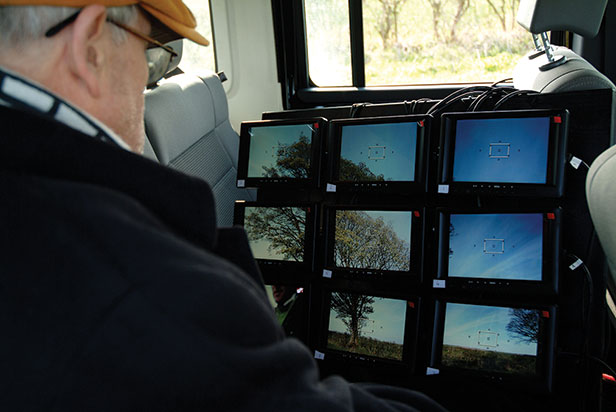
A Lot More to be Seen

David Hockney 'draws' from the video village. ©David Hockney

1 comments Posted by Ross McDonnell
Labels: Artists, Films, Photography
Monday, September 26, 2011
Wattanabe-san
4 comments Posted by Ross McDonnell
Labels: Japan, Photography, Short Films
Wednesday, August 3, 2011
Broomberg & Chanarin: The War Primer
It's not only by virtue of their position as lecturers and educators but primarily by being prolific producers of work, exhibitions, films, books and collaborations with other artists, that Broomberg & Chanarin have been able to adopt a position in the photography world that floats them comfortably above the genres and constraints of image making that most of us seem happy to bind ourselves to.
Always somehow evading classification and definition, perhaps by virtue of being a kind of artistic odd-couple, they have developed their own language of terse and topical, yet playful photographic statements.
Methodically mining our understanding of how we as individuals view and read images and also how our understanding of the photographic image has been constructed for us is often the starting point of their photographic explorations.
This video of their 'What's Next?' presentation is a perfect example.
3 comments Posted by Ross McDonnell
Labels: Photographers, Photography, Videos
Saturday, July 30, 2011
Joia Magazine

Fantastic interview with yours truly (si hables Espanol) this month in Latin American design bible Joia Magazine. Check it out.
1 comments Posted by Ross McDonnell
Labels: Magazines, Photography
Saturday, July 16, 2011
Happy Birthday R.O.S.S.
“YOU are free,” Deng says to me shortly after the Republic of South Sudan has become the world's 193rd and newest country. “You are free”, he repeats. “You go to your place, you bring your peoples... and your cats and you come to live here. In South Sudan”.
Perhaps he is referring to my cows - for Dinka wealth is in their livestock - but I'm sure what he really means is that his sense of place, his personal freedom, has been fulfilled. I feel no freer here than I have had the fortune to be anywhere else.
Deng is filled with pride. He has a nation he can call his own.
He trails off but his eyes remain fixed on me with stern intent. His huge hand clasps mine in the fluid, shifting handshake of the Dinka and then his face cracks into a massive smile. “We are so happy” he says to me before he walks off. My encounter with Deng is one oft repeated during my time in Juba. Their lands will finally belong to the peoples of South Sudan and they are eager to share it with the world.

After twenty five years of civil war against the Northern forces lead by Sudanese despot President Bashir, the loss of two and a half million people including their great leader and martyr Dr. John Garaang, being in the Southern Sudanese capital for the week leading up to independence is an invite to a party like no other.
The weight of war is finally being lifted and the mood is jubilant. Normally beady eyed SPLA soldiers pose for pictures with their Kalashnikov's, tribes from all over the country stage impromptu dance ceremonies in the middle of the street. Dinka men who look like they could jump over a building in a single leap perform to drum beats; ash painted women holding tree branches, babies swinging from their breasts, their tongues clicking from the roofs of their mouths as they sing and shout, slowly shuffle from shady tree to shady tree in endless harmony.
The streets are filled with cries of “South Sudan Oyee.”

Beyond the party though is the business of starting a new country from scratch. For me personally it's a bonus having the same name as Africa's 54th nation - I spend most of my time buying t-shirts and trinkets bearing my mantle - before realising that walking around wearing your own name emblazoned across your chest would feel somewhat ostentatious under normal circumstances.
For now though I am bonded by name to these people of the Republic of Southern Sudan. We are one.
For others, here in Juba, there is the serious task of nation building. The breakfast table at Nimole Logistics, Resort & Hotel is the place to go to rub shoulders with diplomats, Lebanese businessmen and clean cut Americans - whose task here is unclear - but whose chinos and golf shirts remain perfectly pressed despite the 40 degree heat and swirling red dust. By the pool or over instant coffee with powdered milk in the restaurant is where the action is.

Returning twenty somethings, the elite Juba set, lucky enough to have fled the war and have schooled in Melbourne, London or New York sit around in their Prada shades, sometimes discussing how they will build businesses in their homeland but mostly gossiping about who was spotted partying at D-Havana, Juba's hippest local club, the night before.
They are privileged to have escaped the atrocities of the past but hoping to bring their collective experiences to shape the future of their nation, to get their SPLA qualifications and their dual citizenship and, most of all, to be part of the moment.
It is here, under the fans, that deals are hacked out. The nitty gritty.
The future of R.O.S.S.
On it's birthday, July 9th, South Sudan also becomes one of the world's poorest countries, war still rages in the Nuba mountains, people fret the future political ramifications of tribal divisions that are deep set between the Dinka and Nuer tribes. In the villages a 16 year old girl in South Sudan will be more likely to die in childbirth than to finish school.
When the nation enters the UN some days after independence it will do so at or near the bottom of the World Development Index.
It is not a pretty picture but these statistics seem far from the mind at breakfast in Juba. Like any post-conflict society the capital is a boom town. Cash flows and construction is everywhere. The nation's infrastructure and gilt edged government contracts are up for grabs.
Seventy Harley Davidsons are imported for the Independence celebrations for a nation that has just over a hundred kilometers of paved roads. A new hospital is promised for Wau district. Warehouses on the outskirts of Juba will store everything from frozen chickens to military uniforms. The new currency is chatted about. The banks have frozen the distribution of precious US hundred dollar bills in preparation. Cash flow will be an issue. It may not go smoothly.

Journalists pretend to be engrossed in their laptops but they are here at Nimole to people watch and glean information that will get them behind the facade of flag-raising ceremonies and to handshakes with the people who have jumped the gun and set up shop in Juba to quadruple their investments. There is, surely, a story in that.
For the most part I have little cynicism about this new country. Any fledgling economy is open to exploitation but how else will South Sudan maintain any momentum in it's development without presenting a modern face to the world first and foremost. This is Africa after all. My gut however tells me that Juba in five years will be a pretty decent place to be. Interesting at least. My naïve optimism is not met by most however.

These days I am drifting between the airport chasing lost luggage, the press centre chasing accreditation and Dan Eiffe's place. A former Catholic priest who fought with the SPLA, ran arms and married a beautiful Sudanese woman, Dan was here when all but a handful fled.
The writer I am with calls him Sudan's Oskar Schindler. He talks effusively about his twenty something years fighting and living in South Sudan. This is a moment of immense pride for him. A moment he thought he would never see. He will get a South Sudanese passport after independence and live out his days in a land alien to his Irish past that he has given his whole career to be part of. Dan can't move through Juba without impossibly tall Dinka's hugging him. “I've no idea who most of them are” he tells me, until they say “you were with us in the bush, in 1992, you saved my father's life”. “Yes!” Dan says, “I remember now, another Garaang. Tell him I said hello”. “Yes Commander Dan, I will” the Dinkas reply. Dan has seen it all, in Juba he is a true VIP, not just here for a token celebration.
One night over a Jameson he tells me that he weeps for these people. There is no hyperbole or artifice in his voice for he is one of them.

The luggage arrives, as does the press pass. The 9th is here and I have no idea what I am doing. It's fun and the Tusker is cold but as a photographer on the ground the work is hard. The press pack is in full effect and access to stories has been swallowed up by the big media organisations with producers and most importantly with budgets. At this point I am here with a camera like everyone else, trying to get a Kodak moment or two.
We arrive for the independence celebration at the Dr. John Garaang Mausoleum at seven am and the media quickly become as much a part of the event as the crowd of two hundred thousand or so. We sit on the sweltering tarmac for hours waiting and slowly dehydrating. Photographers eyeball each other. Some slip from the security cordon that is intent on blocking our view to get closer to the VIP area where the dignitaries are arriving for their moment on the red carpet. I decide that the time is now but my timing is poor. I get caught in mid-dash towards the podium, the promised land, where the successful have already crossed. The guard has spotted me by the soaked t-shirt I have tied around my head, du-rag style, to ward off the sun. He hauls me unceremoniously back to the press pack.
I get an ironic round of applause for my efforts.
A Sudanese Rick James and his cohorts perform an impromptu pop track on the tarmac. Everyone else is irrate.
Eventually I cross to the sacred other side, where the real photographers are, my head beginning to thump, my left eye half-closed from the soup of sunscreen and sweat that has slow-cooked my retina all morning. The Army parade begins and Salva Kiir, the new President of the Republic of South Sudan is sworn in. The new Constitution is read.
The flag of Sudan is lowered and placed in a glass case as the new flag of R.O.S.S. is raised somewhere in the distance beyond my lens. I lower my camera and sit for a while just watching.
I am here. That much I am sure of. It is history. Right now that's good enough.
I drink the last of my precious water and see the Red Cross pull another unconscious new citizen from the masses. The heat has taken me over too and the stage management, pomp and ceremony has gazumped my desire to carve out any kind of personal perspective on the event. There is no image for me now that I could not sit at home and watch on television. I am ok with it.


I take a break for a couple of hours and return to the Mausoleum in the evening and photograph the aftermath of the great moment. The crowd has mostly dispersed, to careen around town in flag waving convoys or to make their way home
Some remain though and it is far more satisfying to see the locals invade the VIP podium, sitting in the leather armchairs where the new President sat only hours before and stand at the lectern from which He spoke. A sea of South Sudanese flags litters the ground as the rain begins to fall. The pressure has been broken; both in the atmosphere and in the hearts of South Sudan. We catch a glimpse of the big man, Salva, but his security are once again intent on denying us a picture. A party is brewing in the backstage, Colin Powell flies past in a motorcade.

We wrap up the day as the sun breathes it's last breath, fittingly, photographing those coming to pay respects at the actual grave of Garaang, the man who had a vision for his people, a man who, like all great martyrs fought and died for a cause he believed in.
Surreal and already now memorable as a great occasion, the day has gone well for the South Sudanese and all of the preparation, the build up and anticipation are in the past.
A nation has been born.


My time here however is not over. The following days are a blur of encounters and whimsical vignettes, of sitting on building sites and watching laborers construct the new South Sudan, of seeing Hummers fly through the streets and eating salty, roasted goat meat and sipping Ethopian coffee. Of hanging out with Dan telling stories.
It has been a wholly confusing time and I try to figure out how to rescue the week in images that somehow capture the things I have seen. It is a search for a shortcut, for work that other photographers and journalists have put months and years of effort into realising at this moment in time. But really there is no shortcut for me and I resign myself to the fact that this was a wonderful week and this is a wonderful place, photography can wait in the face of bigger, more important things.
Finally I go to the airport on the back of a little motorbike with a trailer on the back. My usual driver doesn't show up and I'm in real danger of missing my flight.
I wave the guy down on the street and promise him ten Sudanese pounds to take me there right now. The jumble of huge ice blocks he is delivering somewhere are melting away in the sun but this Kawaja, me, needs help and the driver seems happy I have chosen him to ride on the back of his little vehicle and not in one of the many Land Cruisers that ferry the foreigners and dignitaries around Juba.
I'm going to make it on time.
The wind and dust from the dirt road blow in my face. I sway and bounce along in the trailer and I realise that Deng might just have been right, I am free.

11 comments Posted by Ross McDonnell
Labels: Photography, Snaps, South Sudan, The Road
Sunday, May 8, 2011
Paddy Englishman, Paddy Irishman, Paddy Afghan?
1 comments Posted by Ross McDonnell
Labels: Photographers, Photography, Videos
Saturday, February 26, 2011
Ssssshhhh! I'm Taking a Thoughtograph...

Fascinating article in The Chronicle of Higher Education about Ted Serios, a Chicago bellhop who, whether true or false, produced 'psychic' photographs or so called 'thoughtographs' during the 1960's and thereby, perhaps, taking photography to the next level.
The article states that Ted produced his images 'by holding a Polaroid camera and focusing on the lens very intently, producing dreamlike pictures of his thoughts on the film'.
Now that I'd like to see...


Images © Ted Serios
There's an exhibition entitled 'Psychic Projections/Photographic Impressions: Paranormal Photographs from the Jule Eisenbud Collection on Ted Serios' at the Albin O. Kuhn Library and Gallery at the University of Maryland-Baltimore County for anyone who's nearby...
96 comments Posted by Ross McDonnell
Labels: Exhibitions, Photographers, Photography
Friday, February 18, 2011
Irish Eyes: Alen MacWeeney

Like a long-legged fly upon the stream
His mind moves upon silence.
That the topless towers be burnt
And men recall that face,
Move most gently if move you must
In this lonely place.
She thinks, part woman, three parts a child,
That nobody looks; her feet
Practise a tinker shuffle
Picked up on a street.
From 'Long-Legged Fly' W.B. Yeats, 1938
It's been a while since the last installment of the 'Irish Eyes' interview series here on the blog and no better way to kick off the new year (-ish) with the opportunity to catch up with Alen MacWeeney, photographer of a towering body of documentary work 'Irish Travellers: Tinkers No More'.
MacWeeney's images appeared to me at a time when frustration and a lack of inspiration were dominant in my photographic world. My usual tricks of poring over 'Dorchester Days' for motivation had begun to fail me and the short days and harsh, dwindling light of Irish winters were only adding to my laziness and my yearning for the photographic exotic; somewhere, anywhere else.
And then I found it, this exotic, in the most unlikely source, close to home. So close to home in fact I wondered how I had never seen these amazing pictures. It was true that the great American photographers had been here to snap pictures of the Irish Gypsies: Dorothea Lange and Mary Ellen Mark among others, but MacWeeney's images were something different, filled with pathos and intimacy.
Not only was the photo book laden with heartbreaking images but also a series of recordings of the Irish Travellers from Cherry Orchard and other 'gyspy' campsites that Alen had gathered during his time photographing 'Tinkers No More', documenting perhaps the most important thing about this unique culture: it's oral history. Songs and conversations, poems and voices spoke from inside caravans from an era long since disappeared. Romantic Ireland was indeed dead and gone.
In essence what Alen managed to capture was a certain interior migration that fundamentally changed the Irish Traveller culture and experience forever, something that does not exist in history books, anthropological studies or any other documents. An essential piece of work by any standards, it's a great pleasure to be able to hear Alen discuss the project in his own words...

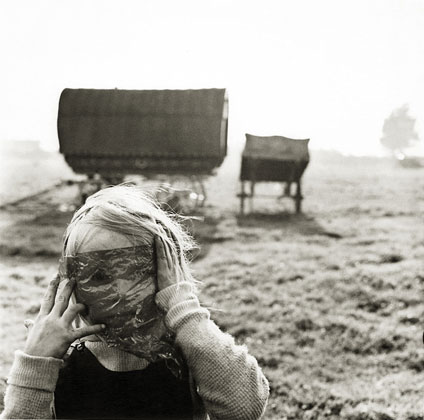
'Child with Cellophane, Cherry Orchard.' by Alen MacWeeney. Copyright 1965
First off, I’d love to get a bit of background to ‘Tinkers No More’. You were living in the US at the time and starting your career as a photographer. What was it like returning to Ireland with a camera in your hand? Things have changed so much there, can you give us your impressions of ‘going home’…
Before my involvement with Travellers, going back in time after a year of assisting Richard Avedon in New York in ’62, I returned to Ireland with an idea of making portraits of the men and women of the Catholic Church, the priests, the nuns, and the church leaders who control the church in Ireland.
But, I failed to find support, or indeed have the wherewithal myself at 22 years of age to manage the underpinnings needed to gain both access and recommendations for the project. At that time there was no hint of scandal attached to the church.
So, I put my Hasselblad aside, bought a Leica, and went out into the streets to photograph for the best part of the next two years in Dublin.
Unlike portrait photographs, which involve choosing and directing not only the subject, but the situation and everything else; I chose street photography which is dependent seeing an image in a myriad of moving parts. And, in essence requires synthesizing a confluence of elements, to make an image in a moment.
I returned to New York in 1964 as a place to find work and where photography found a more supportive audience in a country of limitless possibility. The centenary of the poet W.B. Yeats was in 1965. Harpers Bazaar magazine promised me some pages based on my proposal of a photo essay about the poet and his sources: of the kinds of people, places and things in his poems. With the help of others, I left New York for a year long stay in Ireland to begin this project.

'Woman in a White Dress, Dublin.' by Alen MacWeeney. Copyright 1965

'Watching: A Dublin Street Scene' by by Alen MacWeeney. Copyright 1965

'Glowing White Pony, Ballinasloe Horse Fair' by by Alen MacWeeney. Copyright 1965
Did you know that working with the Traveller community was something you wanted to do or like all great photo essays was it something you just stumbled upon?
I was out one day looking for a Tinker woman to photograph as part of the Yeats essay, and by accident (as I am convinced is the best way to begin anything) I came across a big sprawling field that was a Traveller’s campsite on the scruffy outskirts of Dublin, opposite Cherry Orchard fever hospital.
I went through a gap in the hedge and into a hut and met with Joe Donaghue there, the self-styled leader of the camp. We talked (or rather he talked and I listened) and he gave me a well rehearsed monologue over the next few hours of the injustices the Travellers had been subjected to by the authorities in Dublin and aided by the church. After our initial meeting, I brought up a tape recorder the next day, which became my passport, it lent an air of seriousness and purpose to the interviews. The tape recorder was my ally and helped me to interview many other Travellers in the years ahead.

'Joe Donoghue and Olivene, Cherry Orchard.' by by Alen MacWeeney. Copyright 1965
What I found there in Cherry Orchard would occupy me for the next five years was a deep well of a hidden Irish culture. The Travellers went to Dublin to collect the dole; before ’63 there was none. They could now send their children to school, and due to an increase in motor traffic and restrictions to camping along the roadsides it was difficult for them to maintain that older way of life. By accident, I coincided with the exodus of Travellers from the country into the city.

'Building a hut, Cherry Orchard.' by by Alen MacWeeney. Copyright 1965

'The Ward Family, Cherry Orchard.' by by Alen MacWeeney. Copyright 1965
Now that Traveller culture is set to hit a kind of vogue with the success of the documentary 'Knuckle' and other projects, can you give us an insight into the community at the time you were shooting ‘Tinkers No More’?
I was alone, with a camera and tape recorder, there were no other photographers about, nor were there tape recorders or radios among the Travellers in Dublin then. With the advantage of being able to play back the recordings of the music and songs which began spontaneously one evening and quickly evolved into dense gatherings of children, women and men, singing ballads, playing the tin whistle and telling stories in Joe Donahue’s hut for all the nights I was there that year. The excitement of course centered on the Travellers hearing the recordings of themselves played back for the first time.
As a photographer my presence was welcomed as an unexpected explorer might land in a new world in another era from another place. After a few weeks I began photographing and was treated with little suspicion and accepted into a world completely unknown to me, but gripping. The Smithsonian magazine noted: I “became the first amateur anthropologist of Traveller culture, - by accident.” Accepted and treated as familiarly as another family member, or better. I returned to Ireland in 1999, to co-direct a feature length documentary film, (Little Bird Productions), that was about what happened to the lives of the people in the photographs that I had taken 35 years earlier. Many of my Traveller friends had died or moved away, but others reacted as though I’d only gone to the corner for a bottle of milk. Our friendships have endured and always will.
Your images seem like something from the era of the Farm Security Administration era but you were working at the time with Richard Avedon, presumably not in the field of documentary photography. Did you feel like you were making something original for Irish photography at the time?
I am aware of the Dorothea Lange, Walker Evans quality to the photographs, which may find an answer in that the Travellers were not all that different from the tenant farmers of the American depression, - being also poor, white and dispossessed.
I thought the Travellers were breathtakingly beautiful, with remarkable features; a raw dignity and a fearlessness about them. Of course their raggedy clothes framed and only emphasized their features. And, yes I did feel I was making something original. Irish photography did not exist at that time in my opinion, except for anonymous work.

'Bridget and Paddy Furey with their children, Loughrea.' by by Alen MacWeeney. Copyright 1965

'Julia and Bernie McDonagh, Cherry Orchard' by by Alen MacWeeney. Copyright 1965

'Tommy Hutchenson and girl, Cherry Orchard.' by by Alen MacWeeney. Copyright 1965
What happened to the series after you had finished working in Cherry Orchard, did you maintain contact with the families who lived there? How were the images received?
I have maintained friendship with many families. And yes, the photographs I can only describe as being received as treasured items. That was in 1966 and 1971. I’m sure it is different now, but so many Travellers could not read then and the photograph was an essential link to a family’s past.
Were you tempted to pursue a career in documentary photography and take a more photojournalistic course with your work?
That was my intention, but the failure to find a project of such personal discovery as the Travellers made me feel like an ill fitting hand in the glove of magazines that assigned reportage photography then, and their subsequent decline caused an unexpected adjustment of my future direction.
How do you feel about Ireland today, do you feel this series captured something essential about Irish culture that is now gone, especially regarding the ‘Tinkers’?
The Travellers represented an older way of life to me, as they were connected by a tight family bond. They are adventurous, resourceful and with a wealth of oral traditions they shared with me so willingly. My debt is to them for all of that.

'Ginger Navins (Paddy Rourke), Rathfarnam.' by by Alen MacWeeney. Copyright 1967
Title Image: Bill Cassidey and Kathleen Connors, Saggart' by by Alen MacWeeney. Copyright 1967
18 comments Posted by Ross McDonnell
Labels: Irish Eyes, Photographers, Photography
Tuesday, February 15, 2011
Joyrider hits the New York Times.

It's true that readers of the New York Times may be becoming accustomed to seeing burning cars in the pages of their newspapers. After 18 days of riots in Cairo and the Middle East continuing to rupture; are photos of things getting trashed becoming passe?
Never!
Check out the great slideshow of my Joyrider series on the seminal NYT 'LENS' blog or click on the photo.
Many thanks to Dawn Lim, James Estrin and B.P. LaMotte for putting it together.
5 comments Posted by Ross McDonnell
Labels: Bloggers, Photography, The Portfolio
Sunday, January 16, 2011
Notes from the Crime Beat: Meeting Metinides

Sometimes you get the impression that life really does imitate art and listening to the story of photographer Enrique Metinides, the Godfather of 'La Nota Roja' was one of those times. This week I had the privilege of meeting the man sometimes referred to as the Mexican Weegee at his home in Mexico City; where he told me how he got the nickname 'El Nino'.
A little older now but his tiny frame still buzzing with energy, he begins to show me his collection of DVD's recounting how, in the early 40's he was obsessed with the movies of Al Capone and the noirs and gangster flicks that filled Mexico City cinemas during his youth. This formative time in the boy Metinides' life coincided with his father closing up his city centre camera store to open a restaurant and gifting his son an old Brownie camera and a bag of film to keep him out of trouble. At the age of 10, while helping out in his Dad's new place, Enrique began chatting with the local cops who came in to chow down, popping around to the local police station to snap pictures of corpses and criminals they would drag into the precinct.
By the tender age of 11, Enrique had secured himself a job as a sidekick to one of the photographers from Mexico City's largest daily 'La Prensa' and so began the fifty year career of 'El Nino', the youngest crime photographer in history, a career spent riding around on the top of firetrucks, listening to the police and emergency radio frequencies for news of car crashes, murders and crimes of passion and, in time, photographing perhaps more 'muertos' than even Weegee 'the famous' himself.
As Enrique recounted his - by now well told story - I couldn't help but get the feeling he has managed to live out a real life fantasy that was borne in his early youth watching hard-boiled gangster films of the 1940's. For half a century Metinides endlessly placed himself right at the heart of these horrific scenes as 'that guy with the camera', rendering his images with a cinematic flair that seems a world away from mere tabloid sensationalism. It is something he himself appreciates, the proximity with which he worked, the details and panoramas he captured, the fact his images were used, at times, to solve crimes as much as to seduce the imaginations of a public that devoured the huge photo layouts that filled the papers of the day.
His images defy logic and reason as much as his amazing life does, his photographs, although filled with horrible tragedies have such artistry that for some reason we feel romanticized by them rather than repulsed.
Planes nose dive from the sky, a crashed train zig-zags it's way towards the horizon like a fissure in the ground from an earthquake, an actress lies party suspended, crushed on a lamppost from a car crash only minutes after leaving a beauty salon, her stunning, perfectly made-up eyes frozen in time. Forever.
David La Chapelle couldn't even dream of it. And yet Metinides lived it.
Like other photographers who plied their trade with passion, conviction and sometimes madness in far flung parts of the world only to be discovered by the art world later in their life: Miroslav Tichy, Seidou Keita and Li Zhensheng to name but a few, Metinides has had mixed experiences.
It hasn't really made him rich but his work is appreciated by admirers and collectors around the world. He regaled me with stories of German television crews walking through the same little rooms in his house as I was, the famous collection of 3500 toy firetrucks and other emergency services toys and paraphernalia, press clippings from the exhibition that he had in a former Nazi bunker in Poland, the television sets where he watches action movies, disaster stories and historical documentaries and I couldn't help but get the feeling that even today, long after he put his camera down as the greatest 'Nota Roja' photographer there ever was, the life of 'El Nino' continues to imitate art.


Images Copyright Enrique Metinides
Links:
New York Times
Vice
5 comments Posted by Ross McDonnell
Labels: Mexico, Notes From the Crime Beat, Photography