Monday, February 27, 2012
Hungry Eye
3 comments Posted by Ross McDonnell
Labels: Magazines, Photographers, Photography
Thursday, February 23, 2012
Kamra-e-Faoree
3 comments Posted by Ross McDonnell
Labels: Articles, Photographers, Photography
Wednesday, January 11, 2012
Art...and like fame...and stuff.
from Why is Art so Damned Expensive? in Newsweek/TheDaily Beast...
4 comments Posted by Ross McDonnell
Labels: Articles, Artists, Artwork, Photographers
Saturday, January 7, 2012
My Faraway One
3 comments Posted by Ross McDonnell
Labels: Artists, Photographers, The Coffee Table
Thursday, January 5, 2012
Magnum: Changing of a Myth
Magnum Photos - The Changing of a Myth (1999)
Thanks ASX, the best photo site online...
2 comments Posted by Ross McDonnell
Labels: Photographers, Videos
Monday, November 28, 2011
A life in pictures...
5 comments Posted by Ross McDonnell
Labels: Exhibitions, Photographers, Photography
Thursday, October 20, 2011
Nuru Project

Delighted to be supporting the Nuru Project a really innovative idea by J.B. Reed to help raise money for good causes though photography print sales. Some fantastic work on the website and some really good causes to consider being a benefactor to. Everyones a winner...
8 comments Posted by Ross McDonnell
Labels: Photographers, Photography, Prints
Friday, October 7, 2011
Private Photography Review
1 comments Posted by Ross McDonnell
Labels: Magazines, Photographers, Photography
Wednesday, August 3, 2011
Broomberg & Chanarin: The War Primer
It's not only by virtue of their position as lecturers and educators but primarily by being prolific producers of work, exhibitions, films, books and collaborations with other artists, that Broomberg & Chanarin have been able to adopt a position in the photography world that floats them comfortably above the genres and constraints of image making that most of us seem happy to bind ourselves to.
Always somehow evading classification and definition, perhaps by virtue of being a kind of artistic odd-couple, they have developed their own language of terse and topical, yet playful photographic statements.
Methodically mining our understanding of how we as individuals view and read images and also how our understanding of the photographic image has been constructed for us is often the starting point of their photographic explorations.
This video of their 'What's Next?' presentation is a perfect example.
3 comments Posted by Ross McDonnell
Labels: Photographers, Photography, Videos
Tuesday, June 21, 2011
Tuesday, May 24, 2011
Taryn Simon on The Guardian
3 comments Posted by Ross McDonnell
Labels: Photographers, Videos
Sunday, May 8, 2011
Paddy Englishman, Paddy Irishman, Paddy Afghan?
1 comments Posted by Ross McDonnell
Labels: Photographers, Photography, Videos
Friday, May 6, 2011
Enrique 'El Nino' Metinides, Lightbox by Time
1 comments Posted by Ross McDonnell
Labels: Mexico, Notes From the Crime Beat, Photographers, Videos
Saturday, February 26, 2011
Ssssshhhh! I'm Taking a Thoughtograph...

Fascinating article in The Chronicle of Higher Education about Ted Serios, a Chicago bellhop who, whether true or false, produced 'psychic' photographs or so called 'thoughtographs' during the 1960's and thereby, perhaps, taking photography to the next level.
The article states that Ted produced his images 'by holding a Polaroid camera and focusing on the lens very intently, producing dreamlike pictures of his thoughts on the film'.
Now that I'd like to see...


Images © Ted Serios
There's an exhibition entitled 'Psychic Projections/Photographic Impressions: Paranormal Photographs from the Jule Eisenbud Collection on Ted Serios' at the Albin O. Kuhn Library and Gallery at the University of Maryland-Baltimore County for anyone who's nearby...
96 comments Posted by Ross McDonnell
Labels: Exhibitions, Photographers, Photography
Friday, February 18, 2011
Irish Eyes: Alen MacWeeney

Like a long-legged fly upon the stream
His mind moves upon silence.
That the topless towers be burnt
And men recall that face,
Move most gently if move you must
In this lonely place.
She thinks, part woman, three parts a child,
That nobody looks; her feet
Practise a tinker shuffle
Picked up on a street.
From 'Long-Legged Fly' W.B. Yeats, 1938
It's been a while since the last installment of the 'Irish Eyes' interview series here on the blog and no better way to kick off the new year (-ish) with the opportunity to catch up with Alen MacWeeney, photographer of a towering body of documentary work 'Irish Travellers: Tinkers No More'.
MacWeeney's images appeared to me at a time when frustration and a lack of inspiration were dominant in my photographic world. My usual tricks of poring over 'Dorchester Days' for motivation had begun to fail me and the short days and harsh, dwindling light of Irish winters were only adding to my laziness and my yearning for the photographic exotic; somewhere, anywhere else.
And then I found it, this exotic, in the most unlikely source, close to home. So close to home in fact I wondered how I had never seen these amazing pictures. It was true that the great American photographers had been here to snap pictures of the Irish Gypsies: Dorothea Lange and Mary Ellen Mark among others, but MacWeeney's images were something different, filled with pathos and intimacy.
Not only was the photo book laden with heartbreaking images but also a series of recordings of the Irish Travellers from Cherry Orchard and other 'gyspy' campsites that Alen had gathered during his time photographing 'Tinkers No More', documenting perhaps the most important thing about this unique culture: it's oral history. Songs and conversations, poems and voices spoke from inside caravans from an era long since disappeared. Romantic Ireland was indeed dead and gone.
In essence what Alen managed to capture was a certain interior migration that fundamentally changed the Irish Traveller culture and experience forever, something that does not exist in history books, anthropological studies or any other documents. An essential piece of work by any standards, it's a great pleasure to be able to hear Alen discuss the project in his own words...

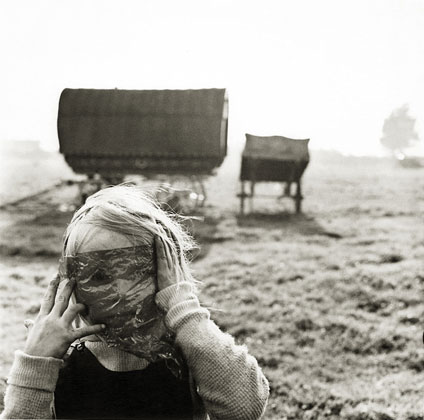
'Child with Cellophane, Cherry Orchard.' by Alen MacWeeney. Copyright 1965
First off, I’d love to get a bit of background to ‘Tinkers No More’. You were living in the US at the time and starting your career as a photographer. What was it like returning to Ireland with a camera in your hand? Things have changed so much there, can you give us your impressions of ‘going home’…
Before my involvement with Travellers, going back in time after a year of assisting Richard Avedon in New York in ’62, I returned to Ireland with an idea of making portraits of the men and women of the Catholic Church, the priests, the nuns, and the church leaders who control the church in Ireland.
But, I failed to find support, or indeed have the wherewithal myself at 22 years of age to manage the underpinnings needed to gain both access and recommendations for the project. At that time there was no hint of scandal attached to the church.
So, I put my Hasselblad aside, bought a Leica, and went out into the streets to photograph for the best part of the next two years in Dublin.
Unlike portrait photographs, which involve choosing and directing not only the subject, but the situation and everything else; I chose street photography which is dependent seeing an image in a myriad of moving parts. And, in essence requires synthesizing a confluence of elements, to make an image in a moment.
I returned to New York in 1964 as a place to find work and where photography found a more supportive audience in a country of limitless possibility. The centenary of the poet W.B. Yeats was in 1965. Harpers Bazaar magazine promised me some pages based on my proposal of a photo essay about the poet and his sources: of the kinds of people, places and things in his poems. With the help of others, I left New York for a year long stay in Ireland to begin this project.

'Woman in a White Dress, Dublin.' by Alen MacWeeney. Copyright 1965

'Watching: A Dublin Street Scene' by by Alen MacWeeney. Copyright 1965

'Glowing White Pony, Ballinasloe Horse Fair' by by Alen MacWeeney. Copyright 1965
Did you know that working with the Traveller community was something you wanted to do or like all great photo essays was it something you just stumbled upon?
I was out one day looking for a Tinker woman to photograph as part of the Yeats essay, and by accident (as I am convinced is the best way to begin anything) I came across a big sprawling field that was a Traveller’s campsite on the scruffy outskirts of Dublin, opposite Cherry Orchard fever hospital.
I went through a gap in the hedge and into a hut and met with Joe Donaghue there, the self-styled leader of the camp. We talked (or rather he talked and I listened) and he gave me a well rehearsed monologue over the next few hours of the injustices the Travellers had been subjected to by the authorities in Dublin and aided by the church. After our initial meeting, I brought up a tape recorder the next day, which became my passport, it lent an air of seriousness and purpose to the interviews. The tape recorder was my ally and helped me to interview many other Travellers in the years ahead.

'Joe Donoghue and Olivene, Cherry Orchard.' by by Alen MacWeeney. Copyright 1965
What I found there in Cherry Orchard would occupy me for the next five years was a deep well of a hidden Irish culture. The Travellers went to Dublin to collect the dole; before ’63 there was none. They could now send their children to school, and due to an increase in motor traffic and restrictions to camping along the roadsides it was difficult for them to maintain that older way of life. By accident, I coincided with the exodus of Travellers from the country into the city.

'Building a hut, Cherry Orchard.' by by Alen MacWeeney. Copyright 1965

'The Ward Family, Cherry Orchard.' by by Alen MacWeeney. Copyright 1965
Now that Traveller culture is set to hit a kind of vogue with the success of the documentary 'Knuckle' and other projects, can you give us an insight into the community at the time you were shooting ‘Tinkers No More’?
I was alone, with a camera and tape recorder, there were no other photographers about, nor were there tape recorders or radios among the Travellers in Dublin then. With the advantage of being able to play back the recordings of the music and songs which began spontaneously one evening and quickly evolved into dense gatherings of children, women and men, singing ballads, playing the tin whistle and telling stories in Joe Donahue’s hut for all the nights I was there that year. The excitement of course centered on the Travellers hearing the recordings of themselves played back for the first time.
As a photographer my presence was welcomed as an unexpected explorer might land in a new world in another era from another place. After a few weeks I began photographing and was treated with little suspicion and accepted into a world completely unknown to me, but gripping. The Smithsonian magazine noted: I “became the first amateur anthropologist of Traveller culture, - by accident.” Accepted and treated as familiarly as another family member, or better. I returned to Ireland in 1999, to co-direct a feature length documentary film, (Little Bird Productions), that was about what happened to the lives of the people in the photographs that I had taken 35 years earlier. Many of my Traveller friends had died or moved away, but others reacted as though I’d only gone to the corner for a bottle of milk. Our friendships have endured and always will.
Your images seem like something from the era of the Farm Security Administration era but you were working at the time with Richard Avedon, presumably not in the field of documentary photography. Did you feel like you were making something original for Irish photography at the time?
I am aware of the Dorothea Lange, Walker Evans quality to the photographs, which may find an answer in that the Travellers were not all that different from the tenant farmers of the American depression, - being also poor, white and dispossessed.
I thought the Travellers were breathtakingly beautiful, with remarkable features; a raw dignity and a fearlessness about them. Of course their raggedy clothes framed and only emphasized their features. And, yes I did feel I was making something original. Irish photography did not exist at that time in my opinion, except for anonymous work.

'Bridget and Paddy Furey with their children, Loughrea.' by by Alen MacWeeney. Copyright 1965

'Julia and Bernie McDonagh, Cherry Orchard' by by Alen MacWeeney. Copyright 1965

'Tommy Hutchenson and girl, Cherry Orchard.' by by Alen MacWeeney. Copyright 1965
What happened to the series after you had finished working in Cherry Orchard, did you maintain contact with the families who lived there? How were the images received?
I have maintained friendship with many families. And yes, the photographs I can only describe as being received as treasured items. That was in 1966 and 1971. I’m sure it is different now, but so many Travellers could not read then and the photograph was an essential link to a family’s past.
Were you tempted to pursue a career in documentary photography and take a more photojournalistic course with your work?
That was my intention, but the failure to find a project of such personal discovery as the Travellers made me feel like an ill fitting hand in the glove of magazines that assigned reportage photography then, and their subsequent decline caused an unexpected adjustment of my future direction.
How do you feel about Ireland today, do you feel this series captured something essential about Irish culture that is now gone, especially regarding the ‘Tinkers’?
The Travellers represented an older way of life to me, as they were connected by a tight family bond. They are adventurous, resourceful and with a wealth of oral traditions they shared with me so willingly. My debt is to them for all of that.

'Ginger Navins (Paddy Rourke), Rathfarnam.' by by Alen MacWeeney. Copyright 1967
Title Image: Bill Cassidey and Kathleen Connors, Saggart' by by Alen MacWeeney. Copyright 1967
18 comments Posted by Ross McDonnell
Labels: Irish Eyes, Photographers, Photography
Tuesday, January 25, 2011
Conscientious-ly

Shout out to the doyen of photo-bloggers J.M. Colberg for featuring one of my favorite snaps from my eternally uncompleted body of work currently titled 'The Afghans'. Joerg also recently featured the work of Irish photographer Kenneth O'Halloran whose large format series on Irish horse fairs has been knocking 'em dead in this heady season of photo-awards. Some epic images of the unique faces of the Irish Travelers who come to buy and sell ponies all over Ireland that are well worth checking out.
In other Traveler related news meanwhile, Ian Palmer's 12 year documentary odyssey on feuding gyspy boxers 'Knuckle' which I wrote about here has been blazing a trail this week at the Sundance Film Festival. G'wan Ian.
Already with precious international distribution secured, Ian's film has gone one step further with Indiewire reporting today that the team that brought us 'Eastbound and Down', namely Danny McBride, David Gordon Green and Jody Hill are hoping to turn 'Knuckle' into a TV series for HBO.
Only time will tell, but can the public handle the idea of an Irish Kenny Powers?
13 comments Posted by Ross McDonnell
Labels: Bloggers, Newsflash, Photographers, The Portfolio
Monday, January 3, 2011
500 Club

Shout out to Pieter Wisse from the wonderful 500 Photographers blog who featured my work this past week. Check it out here
5 comments Posted by Ross McDonnell
Labels: Bloggers, Photographers, The Portfolio
Thursday, September 9, 2010
Irish Eyes: Richard Mosse

Image from the series 'Nada Que Declarar' by Richard Mosse Copyright 2010
The latest in the series of interviews with Irish photographers sees us catch up with the globetrotting photographer and filmmaker Richard Mosse. Only two years since finishing his MFA at Yale and already an emerging international name in the photography world, Mosse has been vigorously producing work that manages to combine the political and intellectual subject matters that he is interested in while managing to make his work a visual feast, a rare feat by any standards.
His photography is a divergent mix of large format projects with each of body of work not quite a photojournalistic photo essay and not quite a fine art series but inhabiting a space in between these crumbling genre boundaries of the contemporary photography world.
Producing images that deal the legacies of conflict, the geopolitics of space and the pliable nature of history, Mosse’s work has it’s roots with contemporary image makers such as Paul Seawright, Simon Norfolk, Luc Delahaye and Edward Burtynsky.
Image from the series 'Breach' by Richard Mosse Copyright 2010
Image from the series 'Nomads' by Richard Mosse Copyright 2010
For me his images differ from what has come before him as Richard seems happy to revel in the practice of the photographic act of devilish suggestion. Fact and fiction are merged at a level where straight-faced truth is normally the order of the day. Whether it’s in war zones, at the sites of natural disasters or in lonely airplane crash sites, the viewer of Mosse's work is never quite able to orient himself in his world but is able to recognize it as something that normally infers grave seriousness.
Image from the series 'The Fall' by Richard Mosse Copyright 2010
With Richard’s work however, we are left to make our own conclusions about what the seriousness of these ‘situations’ is, rather than being told what to think by a newscaster, a narrative or the cliches of Hollywood soundtracks that inevitably open their war stories to the tune of helicopter blades whooshing and the sound of a Muezzin's daily call to prayer.
Memories of images that never existed dance through our unconscious like a kind of photographic déjà vu that calls to mind our own experience as consumers of and subscribers to the 24 hour news cycle, pop culture and the silver screen.
After Kanye West felt the need to big up the work from Richard’s latest series from the Congo on his blog it was clearly time to put him on the spot. Our focus was on this same body of work.
Image from the series 'Infra' by Richard Mosse Copyright 2010
Tell us a little bit about your latest body of work from the Democratic Republic of Congo?
Infra is a photographic foray examining the conflict in Eastern Congo using colour infrared film, a technology originally developed for military reconnaissance.
The images seem to focus on one particular event the FDLR (Democratic Forces for the Liberation of Rwanda) rebel group’s integration into the FARDC (Armed Forces of the Democratic Republic of Congo). Was this series intended to be a kind of interpretation of a single ‘news’ event or is it part of a larger body of work?
I wanted to find a new strategy to represent Congo’s intangible conflict. Though some of the subjects that interest me often appear on the ‘The News’ my work is not intended as a commentary or critique of journalism. It’s simply that I tend to arrive at some of the same destinations as photojournalists. What we notice while we’re out there tends to be extremely divergent.
Image from the series 'Infra' by Richard Mosse Copyright 2010
Tell us a little about your approach to this series, specifically with the use of infrared film. Was there a motivation behind it? The pink is lovely but I’m wondering if there’s a meaning to it all.
I was first turned on to colour infrared photography by Florian Maier-Aichen, a German artist working in California. He has produced some extraordinary photographs of the American west. I’m not sure how they’re made (I’ve heard that he composites them in Photoshop rather than using infrared film). But when I first saw them, I fell in love with the form and wondered how it would operate, exported to a more volatile and loaded landscape.
While I was in the Congo, in early 2010, Kodak announced the discontinuation of this infrared film. I was dealing with an abandoned media which I wanted to use reflexively, to employ this military technology against itself in the hopes of revealing something about how photography represents a place like Congo, a place so deeply buried beneath its representations.
I was especially interested in how Aerochrome perceives and reveals an invisible spectrum of light. In almost all of my work I have to struggle with the challenge of representing abstract or contingent phenomena that are virtually impossible to see, or at least very difficult to put before a camera lens. This is especially the case in Eastern Congo, where my subject was inherently hidden.
The rebel fighters that I hoped to photograph are hunted by the Congolese Army, by rival rebel groups and by the local Mai Mai. They emerge from the jungle to loot and slaughter – this is how they survive – disappearing into the foliage just as quickly. Because it’s possible to exhaust the civilian populations that they prey upon, these groups circulate nomadically in the region. They live by bivouac, constantly moving.
Many of these groups have recently been integrated into the Congolese army – becoming legitimized and uniformed. These killers have simply evaporated, becoming immanent and entrenched.
Where fighting has occurred, it’s trace can be difficult to perceive. Instead of bricks and mortar, Eastern Congo has provisional shacks and a rapacious vegetation that swallows history. Instead of hellfire missiles and military barracks, there are “white” weapons, machetes that kill silently, and rebel militias concealed not by concrete and camouflage, but by the jungle itself.
The decision to use colour infrared film forms a dialogue with these specifics. The poetic associations carried by the pink and red palette are a by-product of this conceptual framework, but a very fertile one. It’s an allegorical landscape – La Vie En Rose – steeped in a kind of magical realism.
Image from the series 'Infra' by Richard Mosse Copyright 2010
There’s a perception in my mind and perhaps for others too that the Congo, the country itself and its history has these powerful cultural connotations of madness attached to it. From ‘Heart of Darkness’ to modern representations of it’s ongoing conflict and the recent saga of General Nkunda, there’s a dark insanity to the whole place more so than perhaps anywhere else.
Do you feel your images are in some way playing into that cultural dialogue or are they commenting on it in some way?
I was deeply affected by Congo’s literary and cultural baggage, by what the name evokes in Western minds which are largely ignorant of the place. This made my journey in Congo extremely stimulating, placing my imagination ‘in the zone’, so to speak. Almost nothing seemed banal to me in the DRC because of these popular mythic associations. My work there couldn’t help but be a product of these cultural undertones.
While making the work, I was acutely aware of the fact that infrared light is invisible, so I was literally photographing blind. The whole process seemed preposterous. I felt like the protagonist in Gogol’s Dead Souls, quantifying an absence using a meticulous scientific method while engaged in a picaresque trajectory through an impossible land.
Does ‘Infra’ represent part of a larger theme you’re trying to address with your work or does each project represent a standalone series?
It’s all related. I am generally drawn to disparate sites around the world that show how the past is constructed by the present, how history is in a constant state of rewriting – rather like the hard disk in your laptop, constantly spinning. I am fascinated by spectacle, myth and monumentality when they relate to politics. I’m also drawn to the limits of representation, to the problems of revealing.
You seem to be working at a frantic pace just now, tell us about how your photographic work has been developing over the last couple of years?
I suppose that’s a result of the Leonore Annenberg Fellowship which Robert Storr awarded me upon graduation from Yale in 2008. This two year fellowship comes with so much cash that it is a real stimulant for producing, as well as being a huge pressure to produce. The Yale Photography MFA was also a bit of a helter skelter in terms of production, so I’ve had four years riding shotgun, making work aggressively.
Image from the series 'Airside' by Richard Mosse Copyright 2010
There seems to be a burgeoning group of photographers working in the spaces between art, photojournalism and documentary photography. Are these definitions redundant? Or do we need to have some kind of genres in photography to help audiences identify with the context of the work?
I don’t think we make genres. Genres are made in the same way that pathways are beaten into the landscape, they are an unconscious result of collective usage.
I feel that there's nothing new about photographers working in the interstices between these fields. What's new is the divergence between the disciplines and the insidious sense that art photography has to look a certain way and photojournalism has to look a certain way, and the twain shall never meet. It's a pointless stratification of the medium. Paul Graham wrote eloquently about this in his seminal essay, 'The Unreasonable Apple'.
I sometimes become confused when my work gets too close to photojournalism. When this happens I try to see what I'm doing as a writer would, imagining my work reflected in a literary mirror. I try to think that instead of taking pictures, I'm writing a novel or a short story or a poem in a place where foreign correspondents hard-boil the facts into succinct dispatches to send down the wire. These are wildly different enterprises, but for some bizarre reason it's hard for us to perceive that difference when it occurs in photographs.
Your images always have a great power to them that connect with viewers. What drew you to the photographic process rather than following your initial interests as a writer?
Writing is an endless lonely journey into the darkness of your own ego. Photography is an endless lonely journey into the darkness of your own ego with air miles.

Image from the series 'Airside' by Richard Mosse Copyright 2010
3 comments Posted by Ross McDonnell
Labels: Interviews, Irish Eyes, Photographers, Photography
Thursday, July 22, 2010
Oooooo...Dedication's What you need...

It must be five years since I last got in contact with the enigma that is Boogie. When I started making pictures and finding my feet as a street snapper, I would pore over his influential Artcoup website/blog, amazed at the access and intimacy he was achieving with his photography just a few blocks away from my Brooklyn base in the heart of Bushwick, photographing the lives of those ruined by crack and heroin addiction.
Long before Tumblr, Facebook and even the mass popularization of blogging, there was Boogie, posting pictures everyday, logging, categorizing, sharing his stream of consciousness with the world.
I wrote to him in 2005 to share my appreciation for what he was doing. "You should join Magnum" I said to him, "or get a big agency to represent your stuff" I suggested. "Yeah, I'm kinda in a fuck everybody kind of place right now" the reply came back "Thanks for your email though". Five years and five published books later and Boogie is still pushing himself and his style to the max, steadily maturing and adding new dimensions to his approach and his work.
Photo District News has a piece on the work from his latest show on their Photo of the Day post today where Boogie talks about this process:
“When the Carmichael Gallery contacted me about doing a show, they were at first surprised by my initial selection … it didn’t include any of the images that people are used to seeing from me, like gangs, drugs and other hardcore stuff. It was a selection of totally new work mostly of normal day-to-day life, and much of it in color. After years and years of shooting only b&w film, I started seeing images in color some time last year, and it opened up a whole new world for me. After going back and forth with the gallery, we came up with a final selection which we called The Uncovering. It’s a pretty apocalyptic series, but I think it really represents the new me.” 
6 comments Posted by Ross McDonnell
Labels: Photographers, Photography